

Overview
SIBS Payment Gateway (SPG) provides two complementary mechanisms for obtaining transaction information:
- Webhooks — push-based notifications triggered by transaction events
- Status API — pull-based endpoint for querying the current state of a transaction
These mechanisms serve different purposes and must be used together to ensure consistency, reliability, and correctness in transaction processing.
Conceptual Model
Webhooks
- Event-driven notifications
- Delivered asynchronously
- Used to inform that a change has occurred
Status API
- On-demand query mechanism
- Returns the current and authoritative state of the transaction
Consistency Principle

Webhook notifications indicate that something has changed, but they do not guarantee that the received state is:
- Final
- Complete
- Delivered in order
For this reason, the merchant system must always validate the transaction state using the Status API before applying critical business decisions.
Critical Implementation Rule
Do NOT:
- Call the Status API during webhook request handling
- Perform heavy business logic before responding
- Block the HTTP response while processing the event
Reason
- Prevent webhook delivery timeouts
- Avoid unnecessary retries from SPG
- Ensure high availability and scalability of the endpoint
Recommended Processing Model
The correct implementation pattern is asynchronous.
Sequence Diagram
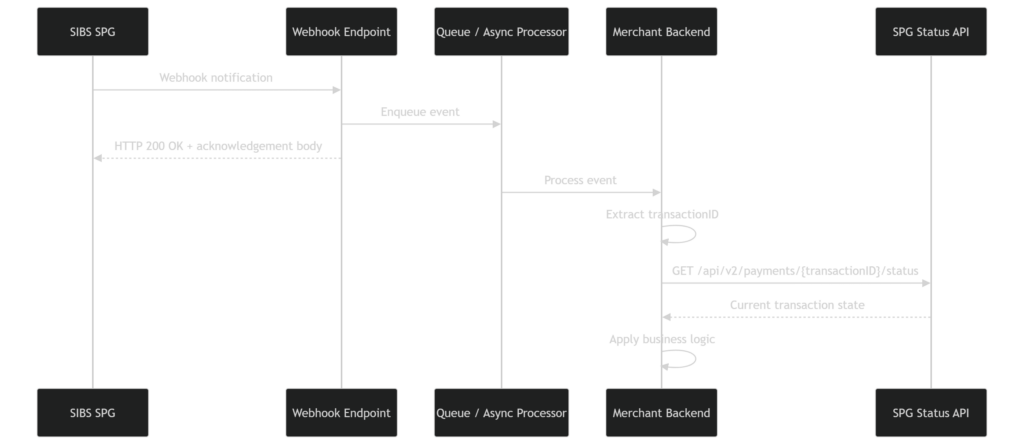
Status API Endpoint
GET https://spg.qly.site1.sibs.pt/api/v2/payments/{transactionID}/statusThis endpoint returns the latest known state of the transaction and must be used for:
- Final state validation
- Reconciliation
- Recovery from missed or delayed events
When to Use Each Mechanism
Use Webhooks to:
- Trigger processing when a transaction event occurs
- React to asynchronous payment updates
- Initiate internal workflows
Use Status API to:
- Confirm the final transaction outcome
- Validate business decisions
- Resolve inconsistencies
- Perform reconciliation
Typical Scenarios
Asynchronous Payment Flow
Webhooks notify that the transaction has evolved, but the Status API must be used to confirm whether the transaction is successful, pending, or failed.
Duplicate or Out-of-Order Webhooks
Webhooks may arrive multiple times or out of sequence. The Status API ensures correct interpretation.
Missing Webhooks
If a webhook is not received, the transaction state can still be recovered through the Status API.
Consistency Risks Without This Model
If the asynchronous model is not respected:
- Webhook timeouts may occur
- SPG retries may increase unnecessarily
- Duplicate processing may be triggered
- System performance and scalability may degrade
- Incorrect transaction states may be applied
Best Practices
- Respond to webhooks immediately with HTTP 200 OK and the expected acknowledgement response body
- Process webhook events asynchronously
- Never chain SPG API calls inside webhook response handling
- Always validate transaction state using the Status API
- Implement idempotent processing
- Log both webhook and status interactions
Summary
Webhooks and the Status API are complementary:
- Webhooks provide event notification
- Status API provides the authoritative state
A correct implementation requires:
- Immediate webhook acknowledgement using HTTP 200 OK with valid acknowledgement response body
- Asynchronous processing
- Status validation before applying business logic
This model ensures scalable, resilient, and consistent transaction processing across all SPG integrations.