

Overview
Webhook-based integrations with SIBS Payment Gateway (SPG) rely on asynchronous event delivery and external system communication. As a result, logging and monitoring are critical to ensure visibility, traceability, and operational reliability.
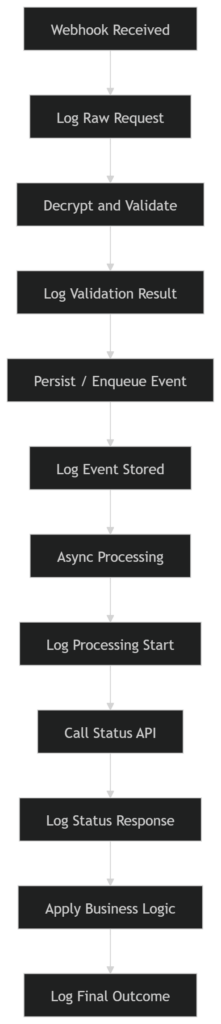
A production-ready implementation must provide full observability across the webhook lifecycle, from reception to final business processing, including interactions with the Status API.
Objectives
The logging and monitoring strategy must enable:
- End-to-end transaction traceability
- Detection of failed or delayed processing
- Diagnosis of integration issues
- Recovery from missed or inconsistent events
- Operational visibility in asynchronous flows
Observability Flow
Logging Strategy
Logging must be implemented at all stages of the webhook lifecycle.
1. Webhook Reception
Log the following:
- Timestamp of reception
- Raw request body (encrypted payload)
- Relevant HTTP headers:
X-Initialization-VectorX-Authentication-Tag
- Request metadata (IP, endpoint, response time)
2. Decryption and Validation
Log:
- Decryption success or failure
- Validation result (valid / invalid payload)
- Errors during decryption (without exposing sensitive data)

3. Event Persistence / Enqueue
Log:
- Event storage or queue insertion result
- Internal event identifier (if applicable)
- Correlation with transaction identifiers
4. Asynchronous Processing
Log:
- Processing start and completion timestamps
- Extracted identifiers:
transactionIDmerchantTransactionId
- Processing outcome (success / failure)
5. Status API Interaction
Log all interactions with the Status API:
- Request timestamp
- Endpoint called
- Response received
- Final transaction state returned
Correlation and Traceability
To ensure end-to-end visibility, logs must be correlated using consistent identifiers.
Primary Correlation Key
transactionID
Secondary Correlation Keys
merchantTransactionId- Internal event ID (if applicable)
Recommended Approach

Monitoring Strategy
Monitoring must cover both technical and business-level indicators.
1. Webhook Delivery Monitoring
Track:
- Number of webhooks received
- Response time of webhook endpoint
- Rate of webhook acknowledgements not complying with the expected contract (HTTP 200 OK with valid acknowledgement response body)
2. Processing Monitoring
Track:
- Queue size / backlog
- Processing latency
- Failed processing attempts
3. Status Consistency Monitoring
Track:
- Differences between webhook events and Status API results
- Transactions without final state confirmation
- Delayed status resolution
4. Error Monitoring
Track:
- Decryption failures
- Validation failures
- Status API errors
- Internal processing errors
Alerting
Alerts must be configured for critical conditions.
Recommended Alerts
- High rate of webhook failures
- Decryption failure spikes
- Processing backlog growth
- Missing transaction finalization
- Status API failures
Reconciliation
Due to the asynchronous nature of webhooks, periodic reconciliation is required.
Recommended Approach
- Periodically query transactions using the Status API
- Compare internal state with SPG state
- Detect and correct inconsistencies
Observability Architecture
A typical enterprise setup includes:
- Centralized logging system
- Metrics and monitoring platform
- Alerting system
- Dashboards for real-time visibility
Best Practices
- Log all stages of the webhook lifecycle
- Use structured logging (JSON recommended)
- Always include correlation identifiers
- Avoid logging sensitive data in plain text
- Monitor both technical and business metrics
- Combine webhook-driven processing with reconciliation
Common Pitfalls
- Not logging webhook payloads
- Missing correlation between systems
- Ignoring failed processing events
- Not monitoring asynchronous delays
- Not validating final state using the Status API
- Lack of alerting for critical failures
Summary
Logging and monitoring are essential components of SPG webhook integrations.
A robust implementation must provide:
- Full transaction traceability
- Visibility into asynchronous processing
- Detection and alerting of failures
- Support for reconciliation and recovery
This ensures a reliable, observable, and production-ready integration aligned with enterprise standards.