

Overview
This section provides a complete, end-to-end example of how webhook notifications are integrated into the transaction lifecycle, including reception, processing, and reconciliation with the authoritative transaction state.
The objective is to demonstrate how asynchronous notifications, API interactions, and internal processing must be combined to produce consistent and correct transaction outcomes in a production-grade SIBS Payment Gateway (SPG) integration.
End-to-End Scenario Description
The following scenario represents a typical asynchronous payment flow:
- A checkout is created
- The payment method is executed
- The transaction enters an intermediate or pending state
- A webhook notification is received with an updated state
- The merchant system processes the notification
- The final transaction state is confirmed using the Status API
This model applies across multiple payment methods where the final outcome is not immediately available at the time of the initial request.
End-to-End Processing Flow
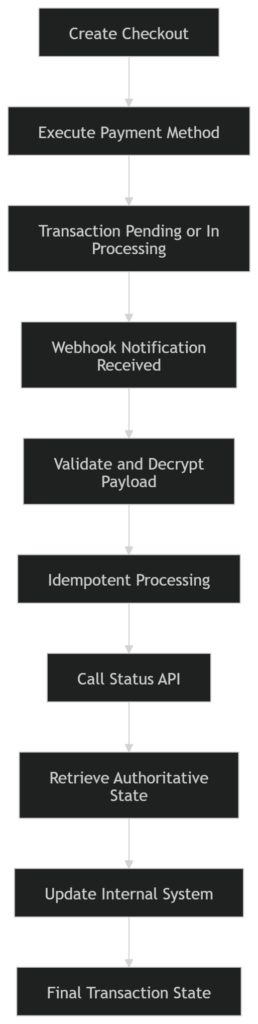
This flow illustrates how webhook processing and status validation must be combined to ensure correct transaction state handling.
Step-by-Step Processing Model
Step 1 – Transaction Initiation
The merchant initiates the transaction through a checkout request and executes the selected payment method.
At this stage:
- A
transactionIDis generated - The transaction may not reach a final state immediately
- Further updates are expected through webhook notifications
Step 2 – Webhook Reception and Processing
When the transaction state changes, SPG sends a webhook notification.
The merchant system must:
- Receive the notification
- Validate headers and structure
- Decrypt and parse the payload
- Extract:
transactionIDnotificationID- relevant state information
The notification must then be processed using the model described in F.10.1 Webhook Reception, Decryption and Processing Flow.
Step 3 – Idempotent Event Handling
Before executing any business logic, the system must ensure idempotency:
- Check whether
notificationIDhas already been processed - Prevent duplicate execution of business logic
- Ensure safe handling of repeated notifications
At this stage, the notification is treated as an event signal, not as final confirmation.
Step 4 – Status Reconciliation
After processing the webhook, the system must confirm the authoritative transaction state.
Call:
GET <ROOT_URL>/api/v2/payments/{transactionID}/statusThe response provides:
- Final
paymentStatus - Authoritative transaction outcome
- Complete transaction data
This step is mandatory to ensure authoritative consistency of the transaction state between:
- event-driven updates (webhooks)
- system-of-record state (Status API)
Step 5 – Internal State Update
Based on the Status API response, the merchant system must:
- Update internal transaction records
- Apply business logic based on the final state
- Trigger downstream processes if required
Examples:
- Mark order as paid
- Trigger fulfillment
- Record failure or retry logic
The system must rely on the status response, not solely on the webhook payload.
State Consistency Model
Webhook notifications and Status API responses represent two complementary views of transaction state:
- Webhooks provide event-driven updates
- Status API provides authoritative state validation
These two mechanisms must be combined to ensure:
- correct interpretation of transaction outcomes
- resilience to delayed or duplicated events
- consistency across distributed systems
Example Flow (Conceptual)
Webhook received:
  paymentStatus = "Success"
  transactionID = "tx123"
  notificationID = "notif001"

Process:
  - Check idempotency (notif001)
  - Accept event

Call Status API:
  GET /api/v2/payments/tx123/status

Response:
  paymentStatus = "Success"

Result:
  - Update order status to PAID
  - Persist final transaction state
This example illustrates the combination of webhook-driven processing and status-based validation.
Handling Non-Final States
Webhook notifications may represent intermediate states such as:
- Pending
- InProcessing
In these cases:
- The system must not assume final outcome
- Status validation may need to be retried
- Business actions must be deferred until a final state is confirmed
This behavior is critical for payment methods with delayed or user-driven completion.
Failure and Retry Considerations
During the end-to-end flow, the system must handle:
- duplicate webhook notifications
- delayed delivery
- temporary inconsistencies between webhook and status
- transient failures in API calls
Correct behavior requires:
- idempotent processing
- retry mechanisms for status validation
- controlled state transitions
- no reliance on a single signal
Final Consideration
A correct SPG integration must treat webhook notifications and status validation as complementary components of a unified processing model.
Webhook notifications provide timely visibility into transaction events, while the Status API provides the authoritative confirmation required for final decision-making.
By combining these mechanisms as illustrated in this section, integrators ensure that transaction handling remains:
- consistent
- reliable
- resilient under asynchronous conditions
This approach guarantees correct behavior across all transaction scenarios and lifecycle states, regardless of timing, delivery order, or external dependencies.